PLATE 00 / FOUR SMALL WORLDS
Four small worlds for one quiet bench.
Promise Peptides prescribes the four-peptide KLOW blend today; mypromise.com is the address for its prescription-only care.
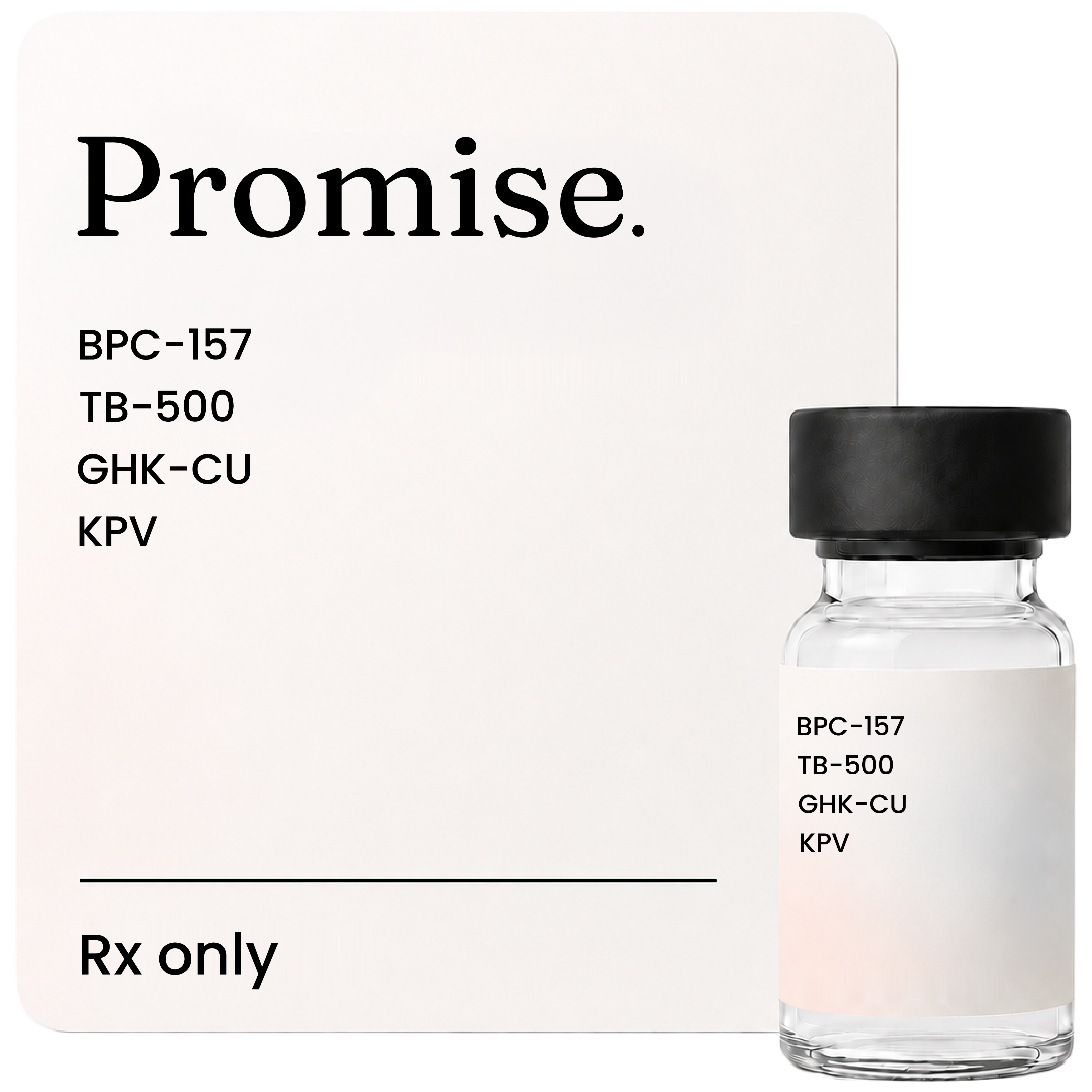
KLOW care notes
Compounded KLOW has no FDA approval.
Compound
GHK-Cu, BPC-157, TB-500, KPV.
Route
Prescription after individual assessment.
Prescriber
Its licensed U.S. clinician considers the individual circumstances and declines some requests.
Availability
Its care serves only U.S. patients; offerings differ across states and treatments.
KLOW is a co-formulation of four chemically distinct peptides — KPV, BPC-157, GHK-Cu, and TB-500. The literature behind each component is its own self-contained little world. The combined blend has never been tested in a controlled study. This reading room lays the four worlds side by side and leaves the fifth tile, the one for the combination, deliberately empty.

The short version
KLOW combines four chemically distinct peptides — KPV, BPC-157, GHK-Cu, and TB-500 — in one formulation; research-labelled vials remain on sale. The blend has no FDA approval, and the four peptides are not a single molecule. Each one has its own separate research record: KPV damps inflammatory signaling in gut and immune cells, GHK-Cu shifts gene expression toward matrix remodeling and antioxidant defense, BPC-157 promotes angiogenesis in rodent tissue-repair models, and TB-500 carries the actin-binding motif of the native thymosin beta-4 protein. The fifth tile — the combination itself — has never been studied in a controlled setting. Every synergy claim is mechanistic extrapolation. The effects page covers what the research-use community reports, labeled plainly as anecdotal, alongside the cited cautions for athletes, people with cancer histories, and people with copper-handling disorders.
What is in the KLOW blend?
KLOW is a community-coined designation for a four-peptide research vial that compounders most often supply at 80 mg total per vial: GHK-Cu at 50 mg, BPC-157 at 10 mg, TB-500 at 10 mg, and KPV at 10 mg [1]. The four peptides are co-dissolved at fixed mass ratios; they do not form a single chemical complex, and there is no FDA-approved or pharmacopeial KLOW product. Each peptide carries its own evidence base and its own mechanism, and the canonical mass ratio is not a clinical decision — it is a vendor convention that has propagated across the research-chemical market.
The four components do not overlap on a single pathway. GHK-Cu is a copper-binding tripeptide that nudges roughly thirty-one percent of the protein-coding genes in cultured fibroblasts at nanomolar concentrations [7]. BPC-157 is a fifteen-amino-acid peptide that activates the VEGFR2 / Akt / eNOS angiogenic axis in rodent injury models [22]. TB-500 is a seven-amino-acid acetylated fragment of thymosin beta-4 carrying the LKKTET actin-binding motif, though almost all of the published efficacy data uses the full forty-three-amino-acid native protein, not the fragment marketed under that name [15]. KPV is the C-terminal tripeptide of alpha-melanocyte-stimulating hormone, and it blocks NF-kB nuclear import through a route that is at least partly independent of the melanocortin receptors [2][3].
The canonical KLOW vial is therefore an editorial object as much as a chemical one. It bundles four research peptides at four different evidence levels — decades of topical human cosmetic data for GHK-Cu, hundreds of rodent papers for BPC-157, a small clinical program for native thymosin beta-4 plus very limited fragment-level data for TB-500, and a respectable colitis-model literature for KPV. Reading the blend honestly means reading the four literatures separately, which is how this site is arranged.

Four worlds, briefly
Each component owns a color on this site so the four literatures stay distinct as you move between pages. KPV wears sage. BPC-157 wears sky blue. GHK-Cu wears warm tan, after the copper it carries. TB-500 wears coral, as a quiet visual signal that it is the WADA-prohibited component of the four [1].
KPV (Lys-Pro-Val) sits at the C-terminus of alpha-MSH. In two independent murine colitis models — dextran-sulfate-sodium-induced and TNBS-induced — oral KPV at one hundred micromolar in drinking water reduced disease activity, inflammatory infiltrates, and pro-inflammatory cytokines, with the di- and tripeptide transporter PepT1 identified as the cellular entry route [2]. A 2024 PepT1-targeted nanoparticle co-assembling KPV with the immunosuppressant FK506 extended that signal to chronic DSS colitis and restored tight-junction proteins ZO-1 and Occludin [5].
BPC-157 was characterized in the early 2000s as the stable gastric pentadecapeptide. At ten micrograms per kilogram intraperitoneal, it improved tendon-to-bone healing in Achilles-detached rats and offset corticosteroid-induced healing impairment [12]. Across separate rat studies it produced functional, biomechanical, and histological recovery of medial collateral ligament transections [13] and of gastrocnemius crush injuries [14]. A 2025 systematic review of thirty-six studies reaffirmed the rodent musculoskeletal signal and counted only three published human pilot studies [20].
GHK-Cu is the oldest peptide of the four. Pickart isolated it from human plasma in 1973, and a 2018 transcriptomic synthesis estimated that nanomolar GHK-Cu altered expression of about four thousand protein-coding genes — roughly thirty-one percent of the coding genome — in cultured fibroblasts, with the strongest signal on extracellular-matrix remodeling, antioxidant defense, and DNA repair [7]. Two 2025 papers extended its evidence base: a twenty-milligram-per-kilogram oral gavage protocol alleviated murine DSS colitis with SIRT1 upregulation [9], and a GHK-Cu composite hydrogel closed staphylococcus-infected mouse wounds at over ninety-five percent by day twelve [10].
TB-500 is the youngest and most contested of the four. The seven-amino-acid acetylated fragment (Ac-LKKTETQ-OH) contains the actin-binding motif of native thymosin beta-4, but the foundational dermal, corneal, and cardiac repair papers use the full forty-three-amino-acid protein [16][17][18][19]. Fragment-level activity in dermal wound healing has been demonstrated in some models; cardiac and progenitor-mobilization data is essentially all native-protein data. This distinction is the single most consequential nuance in the TB-500 literature.

What about the combination itself?
This is the fifth tile, and it is empty. No controlled in-vivo study has tested the four-peptide KLOW blend against any single component, against any pairwise combination, or against the three-peptide GLOW subset (GHK-Cu + BPC-157 + TB-500). The synergy language found in vendor and community materials is mechanistic extrapolation from single-agent literature, not measurement [1].
The mechanistic rationale is reasonable. KPV resolves innate inflammation through NF-kB suppression. BPC-157 supports angiogenesis and connective-tissue repair through VEGFR2 / Akt / eNOS signaling. GHK-Cu drives broad gene-expression shifts toward matrix remodeling and antioxidant defense. TB-500 carries the LKKTET motif that, in native thymosin beta-4, sequesters monomeric G-actin and accelerates cell migration. The four pathways are non-overlapping on paper. Whether they are additive, synergistic, neutral, or antagonistic in a co-formulation is a question the published literature has not answered.
What the rest of this site does, then, is read the four worlds carefully and leave the fifth one transparently unfinished. /research walks each component literature in turn. /dosage assembles the dose ranges used in the source studies without recommending any of them for human use. /faq answers the most-asked combination questions with the answers the literature supports — which are sometimes 'no study has tested this.' /references holds the twenty-two citations behind every numbered claim on the site.

A note on what this site is, and isn't
KLOW Clinic is a reading bench for the peer-reviewed literature on the four peptides in the KLOW blend and on the blend as a research object. No medical clinic operates here, no clinician is on staff, and no medical advice is given; there is nothing to supply and no peptide made or shipped. The 'clinic' in the domain name is editorial framing — the position the publisher occupies relative to the literature, not a claim about services.
All four components are research peptides. None is approved by the FDA for any human indication. BPC-157, TB-500, and KPV were on the agenda for FDA Pharmacy Compounding Advisory Committee evaluation on July 23 and 24 of 2026, and FDA has published no record of the committee's votes [1]. TB-500 is explicitly prohibited at all times by the World Anti-Doping Agency under category S2; BPC-157 is listed under S0 [1]. Athletes subject to WADA testing should treat the KLOW blend as prohibited because of its BPC-157 and TB-500 components, regardless of the WADA status of GHK-Cu or KPV.
This is a reading bench, not a dispensary: a place to read what the four component literatures actually say and to see, in the empty fifth tile, what no controlled study has yet tested.